You have a brand idea, a target customer and a budget. Now comes one of the most important decisions in your product journey: should you build your product through OEM manufacturing or choose private label? The two terms are often used as if they mean the same thing, but they lead to very different costs, timelines, levels of control and risks.
This guide explains the difference between OEM and private label in plain language, compares them side by side, and gives you a practical framework to choose the right model for your brand, whether you sell sportswear, apparel, cosmetics, supplements, electronics or home goods.
Quick answer: Choose OEM when you have a unique design or specification and want full control over the product. Choose private label when you want to launch faster, with lower upfront cost and lower risk, using a manufacturer’s proven product under your own brand.
What Is OEM Manufacturing?
OEM stands for Original Equipment Manufacturer. In an OEM arrangement, you bring the design, specifications and requirements, and the manufacturer builds the product exactly to your instructions. The factory acts as your production arm. It does not sell the product under its own name, and you typically own the design and the brand.
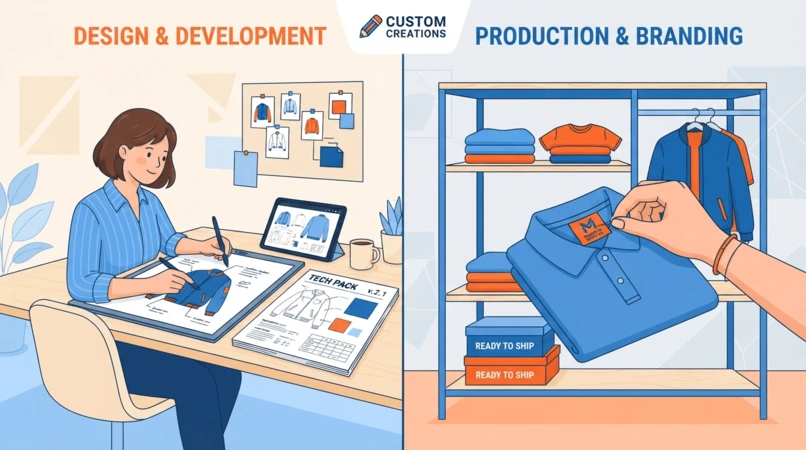
In apparel, for example, an OEM order means you supply a tech pack with patterns, measurements, fabric specifications, stitching details and trims, and the factory produces garments that match it.
Typical OEM traits:
- You own or control the product design and intellectual property
- The product is built to your specifications
- Higher customization, from materials to construction
- Usually higher minimum order quantities (MOQs) and longer development time
- More responsibility for quality specs and testing on your side
What Is Private Label Manufacturing?
Private label means a manufacturer already makes a product, and you sell that product under your own brand name. You choose from existing designs or a catalog, then customize elements such as the label, logo, colors, packaging and sometimes small design details. The core product design belongs to, or is developed by, the manufacturer.
Think of it as buying a proven product and making it yours through branding.
Typical private label traits:
- The manufacturer provides the base product or design
- You customize branding, packaging and some features
- Lower development cost and faster time to market
- Often lower MOQs
- The same or a very similar product may be available to other brands
What About ODM and White Label?
Two related terms often cause confusion:
- ODM (Original Design Manufacturer): The factory designs and builds the product, and you rebrand it. In practice, ODM and private label overlap heavily, and many suppliers use the terms interchangeably. The difference is usually that ODM suggests the manufacturer’s own engineering or design work, with some room for customization.
- White label: A generic product sold to multiple brands with little or no customization beyond the label. It is the most basic and fastest option, and offers the least differentiation.
Because definitions vary by industry and even by supplier, always confirm exactly what a manufacturer means by each term before signing anything.
OEM vs Private Label: Side-by-Side Comparison
Factor | OEM | Private Label |
|---|---|---|
Who designs the product | You | The manufacturer (you customize) |
Customization level | High | Low to medium |
Intellectual property | Typically yours | Usually the manufacturer’s, or shared |
Upfront cost | Higher (design, samples, tooling) | Lower |
MOQ | Usually higher | Usually lower |
Time to market | Longer | Faster |
Product uniqueness | High, hard to copy | Lower, others may sell similar items |
Risk | Higher (design and demand risk on you) | Lower (proven product) |
Supplier switching | Easier, since you own the specs | Harder if the design belongs to the supplier |
Best for | Established or design-led brands | Startups, test launches, fast growth |
Note that these are general patterns. Individual factories vary, so negotiate terms for your specific situation.
Detailed Breakdown: The Factors That Matter Most
1. Cost and Cash Flow
Private label usually wins on upfront cost. There is no design development, the product is already tested, and tooling or pattern costs have been absorbed by the manufacturer. You pay mainly for the product, your branding and packaging.
OEM needs more investment early: design work, sampling rounds, possible tooling, testing and often higher MOQs. However, at scale, OEM can deliver better unit economics because you control materials and specifications and can negotiate on your own design.
2. Control and Customization
OEM gives you control over every detail, including fabric, fit, finish, features and packaging. If your brand promise depends on a specific product experience, such as a signature fabric blend or a unique cut, OEM is the safer path.
Private label limits you to what the factory offers, though good suppliers allow meaningful tweaks to colors, logos, trims and packaging.
3. Speed to Market
Private label can often get you to market in weeks because the product already exists. OEM typically takes longer because it involves design, tech packs, multiple samples and approvals. If you need to test an idea or catch a seasonal window, speed favors private label.
4. Intellectual Property and Brand Differentiation
This is the most overlooked factor. With OEM, the design is yours, and you can protect it through contracts and, where applicable, registrations. With private label, your product may be identical to what a competitor sells under a different name, so your brand story, quality and customer experience must do the differentiating.
5. Quality Control
Both models need strong quality control. With private label, you benefit from a product the factory has already refined, which reduces defect risk. With OEM, quality depends on how clearly you document specifications and how well you inspect samples and production. In either case, use written quality standards, pre-production samples and third-party inspections for larger orders.
6. Scalability and Supplier Flexibility
OEM gives you portability: because you own the specs, you can move production to another factory if prices rise or quality slips. Private label can lock you in if the design belongs to the supplier, so check whether you can exclusively source the product or take the design elsewhere.
Pros and Cons at a Glance
OEM Pros
- Full control over design and specifications
- Strong differentiation and IP ownership
- Easier to switch suppliers
- Better long-term margins at scale
OEM Cons
- Higher upfront investment
- Longer development timeline
- Higher MOQs
- More expertise and management required
Private Label Pros
- Lower startup cost and MOQs
- Fast launch with a proven product
- Less design and technical risk
- Good way to test a market
Private Label Cons
- Limited customization
- Competitors may sell similar products
- Weaker IP position
- Possible dependence on one supplier
Real-World Example: Sportswear Brands
Imagine two brands approaching a sportswear factory.
Brand A is a startup that wants to sell football training jerseys within two months on a small budget. It picks an existing jersey design from the factory’s catalog, adds its logo, chooses colors, sublimates a custom print and uses its own labels and packaging. That is private label, and it launches fast with low risk.
Brand B has a performance-fabric compression line built around a unique seam placement and moisture-wicking blend. It sends a detailed tech pack and fabric specs, approves multiple samples and orders larger volumes. That is OEM, and it protects the product’s identity and gives the brand room to grow.
Many successful brands start as Brand A and graduate to Brand B as they grow.
How to Choose: A Simple Decision Framework
Ask yourself these questions:
- Do you have a unique product design or specification? If yes, lean OEM. If no, lean private label.
- How much budget can you commit upfront? Limited budget points to private label. Larger budget opens up OEM.
- How fast do you need to launch? Within weeks points to private label. You can wait several months for OEM.
- How important is product exclusivity? If it is critical to your brand, choose OEM.
- Can you manage design, quality specs and inspections? If not, private label’s lower complexity helps.
- What volume do you expect? Higher, steady volume justifies OEM investment. Uncertain demand favors private label.
Rule of thumb: If you answered “private label” to most questions, start there. If you answered “OEM” to most, invest in OEM from the beginning.
The Hybrid Path: Start Private Label, Move to OEM
You do not have to choose forever. A popular strategy is to begin with private label to validate demand, learn what customers like and generate cash flow. Once a product sells consistently, you can commission modified or fully custom versions through OEM to improve margins and build exclusivity. Some brands run both models at once: private label for core basics and OEM for signature products.
Common Mistakes to Avoid
- Assuming the terms mean the same thing everywhere. Always define scope in writing.
- Ignoring IP ownership. Clarify in the contract who owns designs, patterns, molds and artwork.
- Skipping samples. Never approve bulk production without checking pre-production samples.
- Choosing on price alone. The cheapest quote often hides quality, compliance or delivery risk.
- Not asking about exclusivity. Ask whether the factory can sell the same product to your competitors, and whether you can secure exclusivity.
- Overlooking compliance. Confirm certifications, labeling rules and safety standards for your target market.
Questions to Ask Any Manufacturer Before You Commit
- Do you offer OEM, private label, ODM or all three, and how do you define each?
- What is your MOQ for each model, and does it change by product or color?
- Who owns the design, patterns and tooling after production?
- Can you guarantee exclusivity for my product or region?
- What are your sampling costs and timelines?
- What quality control process and certifications do you have?
- What are your payment terms and typical lead times?
- Can I visit, or arrange a virtual or third-party audit?
Conclusion
There is no universally better option, only a better fit for your brand’s stage, budget and goals. Choose OEM if you want a unique, protectable product and can invest the time and money to build it. Choose private label if you want to launch quickly, keep costs low and learn from the market first. And if you are unsure, start with private label, then graduate to OEM as your brand and volumes grow.
Next step: Shortlist two or three manufacturers, request samples and quotes for both models, and compare them against the framework above before you commit.
Frequently Asked Questions (FAQ)
What is the main difference between OEM and private label?
With OEM, you supply the design and the factory builds to your specifications. With private label, you sell a manufacturer’s existing product under your own brand with limited customization.
Is OEM better than private label?
Neither is universally better. OEM offers more control and differentiation, while private label offers speed, lower cost and lower risk. The right choice depends on your budget, timeline and product goals.
Which is cheaper, OEM or private label?
Private label is usually cheaper upfront because it avoids design and development costs and often has lower MOQs. OEM can become cost-efficient at higher volumes.
Do I own the design with private label?
Usually not. The manufacturer typically owns or controls the base design. You own your brand name, logo and packaging. Confirm ownership and exclusivity in a written agreement.
Is private label the same as white label?
Not exactly. White label products are generic and sold to many brands with minimal changes. Private label usually offers more customization and a stronger brand identity, sometimes with exclusivity.
Can I start with private label and switch to OEM later?
Yes. Many brands begin with private label to test demand, then move to OEM for custom or exclusive products once sales and volumes justify the investment.
Is OEM or private label better for a small business?
Most small businesses and startups begin with private label because of lower costs, lower MOQs and faster launches. Small businesses with a truly unique product idea may still choose OEM.