Introduction
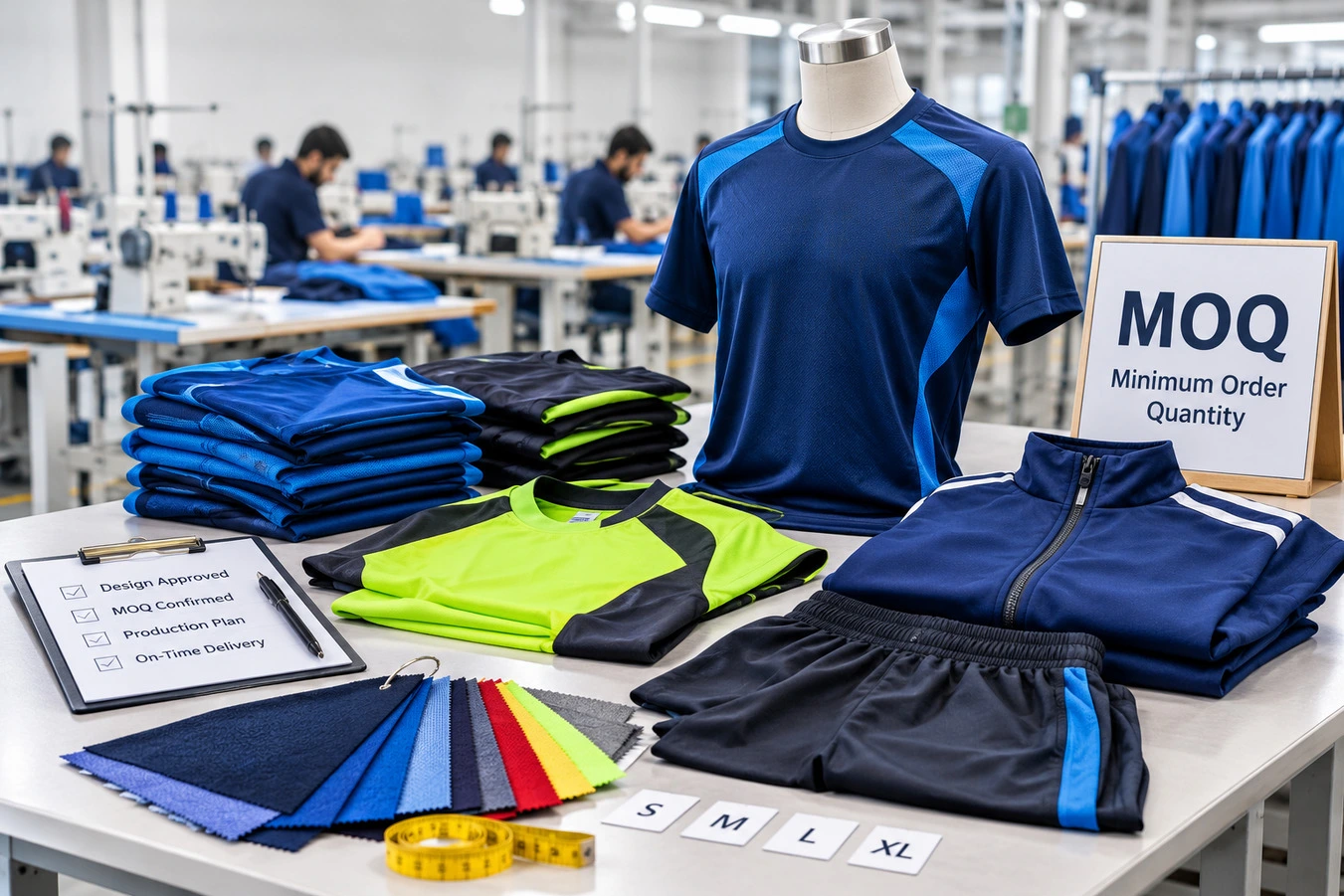
When ordering custom sportswear, one of the first things buyers encounter is the term MOQ, or Minimum Order Quantity. Whether you are launching a sportswear brand, sourcing team uniforms, or working with a private-label manufacturer, understanding MOQ can help you manage costs, plan production, and avoid unnecessary inventory.
For sportswear manufacturers, MOQ helps determine the minimum number of garments required to produce an order efficiently. For buyers, it affects everything from product pricing and customization options to the total investment needed to launch a collection.
In this guide, we explain how MOQ works for custom sportswear orders, what factors influence it, and how you can negotiate a suitable order quantity with your manufacturer.
What Is MOQ in Sportswear Manufacturing?
MOQ stands for Minimum Order Quantity. It refers to the smallest number of garments a manufacturer is willing to produce for a specific order.
In custom sportswear manufacturing, MOQ can apply to a specific product style, a particular colour or colour combination, a complete design or collection, a customization such as embroidery or custom labels, or a production order involving unique fabric or materials.
For example, a manufacturer may require a minimum order of 30 custom football jerseys per design. A buyer can order 30 jerseys in different sizes if the manufacturer allows size mixing. The MOQ may change if the buyer requests custom-dyed fabric, special printing, or additional branding.
The key point: MOQ is not always the same for every product or manufacturer. It depends on the production process, materials, customization requirements, and factory policies.
Why Do Sportswear Manufacturers Set MOQ?
1. Fabric and Material Procurement
Sportswear manufacturers often purchase fabrics in rolls or batches. When a buyer requests a specific fabric, colour, or performance feature, the factory may need to purchase materials specifically for that order. A custom compression shirt, for instance, may require polyester-spandex performance fabric, moisture-wicking material, specific fabric weight and stretch properties, and custom colour matching. Small orders can leave unused fabric behind.
2. Printing and Customization Setup
Custom sportswear may use sublimation printing, embroidery, screen printing, heat transfers, or other branding methods. Each process has setup requirements. Screen printing may need separate screens for different colours; embroidery can require artwork digitizing and machine setup. Setup costs are spread across the order, which is one reason larger orders often receive lower unit prices.
3. Production Efficiency
Garment manufacturing involves cutting, stitching, finishing, and inspection. Factories can often organize production more efficiently when making a larger batch of identical or similar garments. Producing 100 jerseys with one design may be more efficient than producing 10 jerseys across 10 different designs.
How MOQ Is Calculated for Custom Sportswear
There is no universal MOQ calculation used by every sportswear manufacturer. Manufacturers generally consider material requirements, production setup costs, labour, customization, and the time needed to complete an order.
Example: Custom Football Jersey Order
Imagine a factory MOQ of 30 pieces per design. A buyer orders 5 small, 8 medium, 8 large, 6 extra-large, and 3 double-extra-large jerseys. The total is 30 pieces, so the order meets the MOQ if the factory permits size mixing.
If the factory requires 30 pieces per colourway, splitting the order across multiple colours may require additional quantities. Confirm whether MOQ applies per design, per colour, or per complete order.
MOQ Per Design vs. Per Colour vs. Per Order
MOQ Per Design
Each unique design must meet its own minimum. For example, three designs at 30 pieces each would mean a total order of 90 garments.
MOQ Per Colour
Some manufacturers require a separate minimum for every colour variation. This matters especially when custom fabric dyeing is involved.
MOQ Per Order
An order-level MOQ allows buyers to combine different products or styles to reach the total quantity. The factory still needs to confirm which products can be combined based on fabric, printing, and customization requirements.
Does MOQ Affect the Price of Custom Sportswear?
Yes. Larger orders can allow manufacturers to distribute fixed production costs across more units, potentially reducing the price per garment. A lower unit price does not automatically mean a better business decision: a large order may require more upfront cash and create inventory risk.
How to Calculate Total Order Cost
Total order cost = Quantity × Unit price. For example, 100 garments at $15 each gives a garment production cost of $1,500. Additional expenses may include sample development, custom labels and packaging, freight, import duties and taxes, and inspection fees. Request a complete quotation to calculate landed cost.
What Is a Typical MOQ for Custom Sportswear?
MOQ varies significantly by manufacturer and product category. Some factories support startup-sized orders, while others focus on large-scale production. Custom football uniforms may have different minimums from private-label gymwear or technical compression garments.
Treat any stated quantity as a supplier-specific example, not a universal industry standard. Confirm the MOQ directly with the manufacturer and ask whether it applies per style, colour, design, or order.
How to Negotiate a Lower MOQ
1. Start With Existing Designs
Ask whether you can customize an existing product instead of developing a completely new garment. Using an existing pattern, fabric, or construction method may reduce development requirements.
2. Mix Sizes Within One Design
If size mixing is allowed, you can meet the MOQ without ordering the same size in every garment. This is useful for sports teams, clubs, and retailers.
3. Keep the Initial Colour Range Small
Starting with one or two colours instead of five may simplify material sourcing and production planning.
4. Ask About a Higher Unit Price
Some manufacturers may accept smaller quantities if the buyer agrees to a higher unit price. This can be useful when testing demand, but the factory must confirm feasibility.
5. Build a Long-Term Production Relationship
If you expect repeat orders, share realistic future plans. A manufacturer may be more willing to discuss flexible terms when an initial order supports a credible long-term relationship.
MOQ for Private Label Sportswear
Private-label sportswear allows businesses to manufacture garments under their own brand. Customization may include woven labels, neck labels, hang tags, packaging, logos, artwork, garment colours, and designs.
MOQ can differ depending on whether you are customizing an existing product or requesting new product development. Adding a logo to an existing design may be simpler than creating a new pattern, sourcing special fabric, and developing custom packaging. Branding components may also have separate minimum quantities.
Before placing a private-label order, confirm the MOQ for garments and every additional branding requirement.
How to Place a Custom Sportswear Order
Step 1: Share Your Requirements
Provide product type, design, colours, sizes, target quantity, and customization details.
Step 2: Confirm MOQ and Pricing
Ask for minimum quantity, unit price, sample cost, production timeline, and payment terms.
Step 3: Approve a Sample
Check fabric, fit, stitching, print quality, and construction before bulk production.
Step 4: Begin Bulk Production
After sample approval, production begins according to the confirmed specifications.
Step 5: Quality Inspection and Shipping
Inspect completed garments, pack them, and prepare them for delivery.
Frequently Asked Questions
What does MOQ mean in custom sportswear?
MOQ means Minimum Order Quantity. It is the minimum number of garments required for a production order, design, or colour variation.
Can I order custom sportswear in small quantities?
Yes. Some manufacturers offer flexible minimums for startups, small teams, and emerging brands. Availability depends on product and customization.
Can I mix sizes in a custom sportswear order?
Many manufacturers allow size mixing within one design. Confirm the policy before ordering.
Does MOQ include samples?
Bulk MOQ and sample orders are usually treated separately. A manufacturer may allow a sample before a bulk commitment.
Why is the price higher for smaller sportswear orders?
Smaller orders have fewer garments across which to distribute fixed production and setup costs, so the unit price may be higher.
Can I negotiate MOQ with a sportswear manufacturer?
You can discuss smaller quantities, existing designs, limited colours, or a higher unit price. The manufacturer must confirm feasibility.
Is MOQ the same for every sportswear product?
No. Jerseys, gymwear, compression garments, and tracksuits may have different minimums based on materials and production methods.
Conclusion
Understanding how MOQ works for custom sportswear orders is essential for making informed purchasing decisions. MOQ affects production costs, material sourcing, customization, pricing, and inventory planning. By understanding whether the minimum applies per design, colour, or complete order, buyers can plan purchases more effectively.
For new sportswear brands, start with a manageable quantity, approve a quality sample, and build a production relationship that supports future growth. Before ordering, confirm MOQ, unit price, customization requirements, sample approval, and production timeline with your manufacturer.